Hello, everyone...
While in Madrid on holiday, I had the opportunity to visit the Plaza de Toros, the famous bullfighting ring. This place is considered to be the home of bullfighting in Spain. It was made to seat 20,000 people but actually seats 23,000 people approximately. It has a Royal Box for the President (and also the King if he is there) and seats in both the shade and sun. And then, of course, there is the large sandy pit where the matador will publicly kill a bull after 'outwitting' it. For those who love the sport of bullfighting, it is considered an art form because there is no competition involved and the matador must perform several different moves with the bull, almost like a dance.
 |
| The Ring |
The structure of a bullfight is deeply engrained into tradition. In Spain, a bullfight is called corrida de toros and is split up into four separate parts. The first part is the parade, where all the participants of the bullfight come into the arena and salute the President (and the King if he is there.) We, (my brother and I) had an audio guide during the tour and it said that the costumes that the bullfighters wear are made by hand. If that is true, that is amazing because the details on each costume is incredible.
And then, there is the first part of the actual fight, which is called the Tercio de Varas. The audience first see the bull released into the arena, where the matadores and banderilleros engage the bull with a cape, making the bull charge it and observing weaknesses in the bull and which side the bull favours. Then, in the same part, picadores will enter the arena on horseback. (The horses are blindfolded and wearing padding for protection.) The picador will proceed to stab the bull in the shoulder/back of the neck with a lance. It is the first blood drawn.
The second part is called the Tercio de Banderilleros. Three banderilleros each attempt to stick two barbed sticks into the back of the bull. Sometimes, the matador will also try and stab the bull with his own stick. This further weakens and angers the bull.
The last part is called the Tercio de Muerte, where the matador will re-enter the ring alone, with only a cape and a sword. He uses the cape to show his dominance over the bull, by causing it to charge particularly close to his body. Then, he will stab the bull through the heart with the sword.
Very rarely, if the bull had done especially well and the audience have liked him, they will wave their handkerchiefs and the President will have to decide whether or not to let the bull go.
The building itself is actually very interesting though, whether or not you like the sport. From the outside, it looks a bit like a gladiator ring or something else from ancient Rome. It is all very grand and patriotic with the Spanish flag hanging from the roof. Over the door, there are mosaics that tell the history of bullfighting. The arena is in the centre and takes up most of the space in the building. There are seats in the sun and in the shade, the latter being more expensive obviously, but also the price of seats depends on how close you are to the ring. Around the edges of the arena were the tunnels that are used to release the bull into the ring. The bullfighting season is from March to October and so, as we walked around the edge of the ring, we could hear the bulls that were being kept in stables next to the arena. For some reason, in front of the stables, there was a taxidermy of a real bull. Why? I don't know. The Plaza de Toros is a circular building but at the back, in a separate area are the stables for the horses that are used in the parade and by the picador. We saw the padding that is used for protection. It was huge. I know that bulls are extremely strong animals and their horns are extremely dangerous, but this was ridiculous. It is a wonder that the horse can stand up, let alone carry a person on its back and move around. There is also an infirmary, (because bulls can kill and/or gore or permanently injure the matadors with their horns) and a chapel that we did not see.
 |
| Outside of the Plaza de Toros |
 |
| Outside of the Plaza de Toros |
 |
| The stands |
 |
| Artwork at the back of the building |
 |
| The Royal Box |
Now, I am sure I could go on for a long time about bullfighting and the points for it and against it but that would get boring. I am going to say though that, to me, bullfighting is an unnecessary part of tradition. It is cruel, no matter whether or not the bulls for a ring have a better life than the bulls used for food and it is barbaric. I was talking about this to a Spaniard here in Spain and they said that bullfighting is an art form, a 'dance' was the word they used to honour the strength of the bull. I was told that I should not ridicule it because it was very important to many people. But to me, in the same wag bear baiting was stopped and dog/cock fighting in England, I think some traditions should be removed as to keep them is to keep a very primal way of thinking. I won't go into details about the life of the bull in the last days before it is sent to the ring but there is nothing about it that honours the strength or the grandeur of this animal that is driven into a fury before being killed in a heinous way in front of thousands of people.
Okay, well that is it for this blog post. There will probably be a few more like it because I had the pleasure of visiting many cool places in Madrid and in Spain. What is your opinion on bullfighting? Is it a sport that can be justified because it is part of tradition? Or is it just cruel?
B.T.W. I am sorry for the quality of my photos. I am not the best with a camera :/
Clare


 These gardens were free to get into, though. There was also a large house, as you can see in the photo above. I was told that no one is living there at present but we didn't go inside it, so I don't know. (I would just like to say that while I am writing this, the sky is very overcast and I am looking at that sky above the house and just wishing that I was back in Spain...anyway! Back on track!) I don't know who made these gardens so I won't be able to tell you anything about that but I can say that it was very exotic. There were all these different fountains and pools that were decorated with statues. Some statues were gold, some were silver, some were bronze. It was really incredible. They were all different shapes and sizes, some were on different levels, some were square, some were in a semi-circle. It was amazing. Also pictured above are some of the statues in front of the house that we saw. I have to say some of those were slightly odd, there were sphinxes and women with children growing out of their backs but some were cool so you know. Each to his own, I guess.


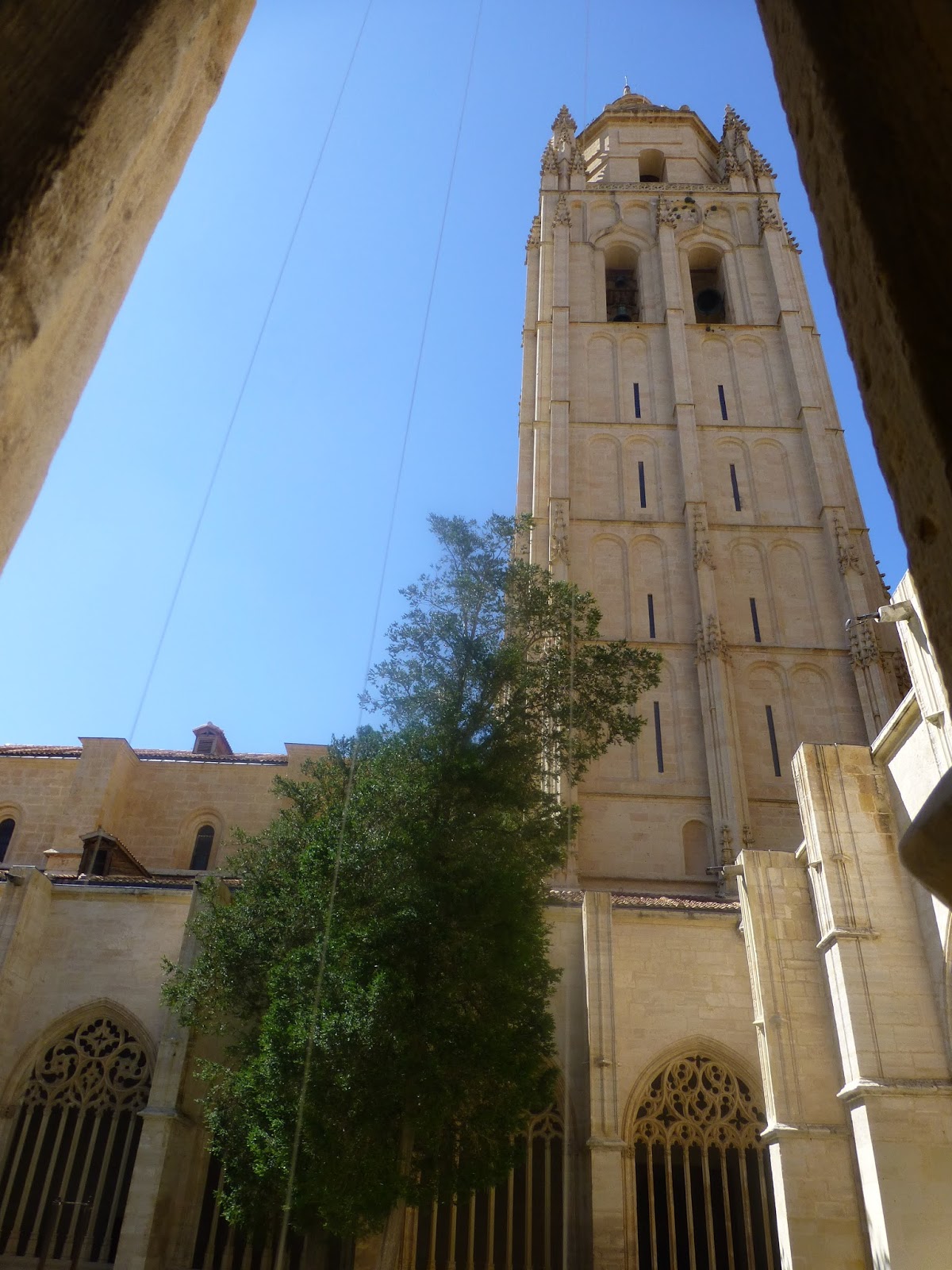
 And then, we went to the actual city of Segovia. In terms of geography, I think it must be quite high up but then again, it is surrounded by mountains, so I am not sure. We did have to climb many stairs to get up to it though. In the picture, you can see the cathedral in the background and that was the first place we visited in Segovia. Now, being a Catholic, I have been in so many cathedrals in my life across the globe, in Italy and France and Brazil and everywhere. But Segovia's cathedral wins the prize for being the best. Whoever built it, *applauds*. You did your job well. Even the organ was covered in gold leaf and icons and decorations and things. It was mind-blowing. And all around the edge of the cathedrals were these shrines to different saints and every single one of them was decorated in a different way. If you like cathedrals, for some reason, this one is a must see. You can even climb the tower but it was closed when we went there. I think you have to go in the morning or something. The detail on everything was extraordinary; the gates were all decorated, the ceiling was decorated, the floor was decorated. Above every archway there was some decoration or design. It was amazing.



 And then, after the cathedral, we went to the edge of Segovia where there is a Roman aqueduct. Apparently, in the past, Segovia used to be a river and so the Romans built this aqueduct to channel the water. And here it is. (Sorry for the people in front of it but it was so crowded.) If you at centre in the top row, there is a little statue of Mary. I was told a legend that had to do with pagans and Christians but I am not sure of the exact details. The story went that some pagans were going to try and build the entire aqueduct in a night and they managed it except for that little bit there and so the Christians put the statue there instead. I don't know. But it was something like that. And then you could climb up this huge flight of stairs and be at the same level as the top level of the aqueduct. And you can see all these mountains surrounding Segovia and there is one that the locals call the 'La Mujer Muerta' which means the dead woman because it looks like a woman who has died in childbirth.


